Tauranga, New Zealand; Kiwi's and Truffles
Monday, February 24, 2025 (Southern Hemisphere, that is)
We are up just in time to view our passage into Pilots Bay where we will dock for our one day visit to Tauranga, New Zealand. Tauranga is the fifth largest city and the bay area was named Bay of Plenty by Cpt. Cook in 1769. He named it that because of the plentiful food sources that he found there. Today, it is the home of many kiwifruit orchards, avocados, citrus orchards and a variety of fresh seafood as well as thriving dairy farms.
It looks to be another beautiful day as our luck continues to bless us with great weather. Our scheduled tour "Truffle Treasures" doesn't start until 1PM, so we are in no hurry to get off the ship. So, we have a leisure breakfast but get filled up as we aren't sure when or what is in store for us on the excursion. We aren't due back from it until 5:30 when the ship is scheduled to leave.
We decide to leave the ship and do some geocaching which there are several close by, mostly Adventure Labs that we like to do. We go ashore about 9:30 and there is a Virtual cache close by which we find and answer the required questions to get credit for the find. The city is actually across the harbor from us and we are docked in Pilot Bay located on a peninsula that is terminated by the Mount Maunganui, an extinct volcano, a sacred Maori site with ocean-view hiking trails and a popular site for climbing and launching paragliders. It is 761 feet high and we see several in the air as we walk the bay side beach on a boardwalk. This is one of the most popular holiday destinations for New Zealanders and foreigners alike. There are lots of sail boats anchored and sailing in the bay along with kayakers, swimmers and families enjoying the beach.
Queen Anne across the bay
Sue takes advantage of the beach area to dip her toes in which seems be a thing with her. We are doing an Adventure Lab that will take us part way up the hiking trail where we get a good view of our Queen Anne across the bay. This is one of five different locations that will take us to the other side of the peninsula which will be the Pacific Ocean and good surfing waves crashing ashore.

Sue dipping with Mount Maunganui
in background

They grow three kinds of kiwi, Gold 80%, Green 19% and a new variety, Red 1%. The gold is sweeter, green is tart and the red is in between. Kiwi fruits are very susceptible to bruising which ruins them. Kiwi orchard showing netting
and wind barrier
Even strong winds can bruise them and an occasional hail storm is devastating. They protect them by covering them with high density polyethylene nets which also helps keep the birds from eating them and reduces chances of sunburn. Hanging gold kiwi soon ready for harvest
They also surround the fields with single row evergreen trees and/or bamboo. These require constant trimming but are necessary for wind protection.


They cannot be machine harvested due to their bruising sensitivity, so hand harvesting is required. Unfortunately, there aren't enough hands for the harvest and workers have to be imported from neighboring islands as far away as Tonga and Samoa. Much the same as our southwestern vegetable and citrus growers import Mexican laborers to do the job.
We board our bus for our next stop, Trufflewood. Lance and Nikki Dodd and their two teenagers run this farm which happens to have a grove of hazelnut and English oak trees whose roots have been innoculated with the truffle spore. This was done by the previous owners who started this relationship with touring companies to help educate the public and hopefully increase the demand for their product.
The below commentary was borrowed from the website: foodunfolded
Truffles are notoriously difficult to cultivate. But in France, thanks to centuries of practice, an amazing 95% of truffles come from agriculture. To get this right, farmers raise saplings from seed in a controlled environment, before introducing truffle spores into the root system, where they grow in a symbiotic relationship with species like oak, beech, hazel, or fir. Truffles also grow symbiotically with trees in the wild. But the spores are spread with the help of wild animals like pigs and bears. Read on to find out more about how truffles, "the black diamond of the kitchen", are grown.
What are truffles?
Truffles are fruiting bodies (aka spore
Like plant seeds, spores are microscopic particles used by fungi to reproduce.
-producing organs) of the fungi family ‘Ascomycota’. Functionally, they are pretty much like mushrooms, except they grow under the soil. The main biological function of a truffle is to spread spores, which in turn gives rise to new offspring.
How are truffles grown?
Since truffles grow under the soil, the way they spread spores is slightly different from how mushrooms do it. Truffles use their unique aroma to attract ‘fungivores’ who enjoy snacking on them.
When consumed, most of the flesh is digested, but the spores pass through the animal’s body unscathed. These spores get back into the soil via the animal’s feces, which is usually deposited in a nearby area. This is especially important because the spores will need to find their way to the roots of their host trees, which are often local to specific ecosystems.
Unlike most plants that can convert sunlight into energy in a process called photosynthesis, truffles are instead totally dependent on certain trees to carry out this process for them. In return, the truffle helps its host tree by using its hyphae to reach nutrients and water from pockets of soil that the tree cannot reach by itself.1
This kind of symbiotic relationship between fungi and the roots of a tree is called mycorrhiza.
Much like animals, humans are attracted to truffles because of the scent they produce. The aroma and taste of truffles is often described as musky, earthy, and pungent and can be attributed to the pheromone androstanol and other volatile compounds.
Truffles need to be recovered (foraged) from under the soil. Traditionally, this was done with help from pigs. Sows are attracted to the scent of truffles because truffles contain the pheromone androstanol which is a sex hormone also found in the saliva of male pigs. However, it is incredibly difficult to convince the sow not to eat the truffle after she works hard to locate it. Dogs on the other hand, are also great sniffers and will happily settle for an alternative treat. Therefore, truffle hunters today prefer to use trained dogs for their foraging trips. (End borrowed commentary.)
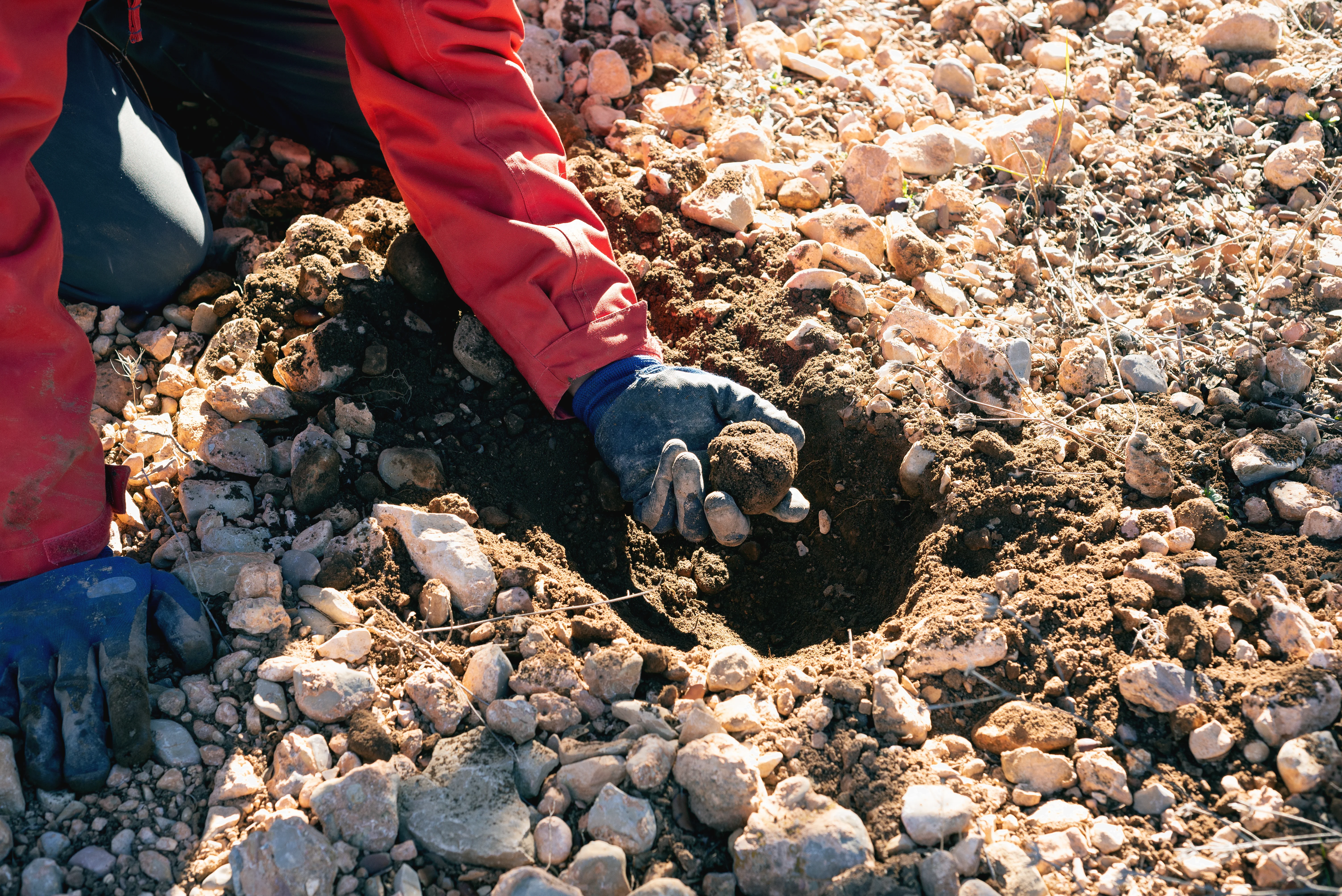
Lance and Nikki gave us a tour of their truffle grove and explained some of the difficulties of maintaining and cultivating their truffles. Lance sprayed the bottom of our shoes before entering the area so as not to bring in any unwanted contaminants. Pine trees are the enemy of truffles which he has plenty on his farm but he doesn't want them near his truffles. The oak and hazel trees have been alternately planted with enough space between to let in the right amount of sunlight to promote truffle propagation. In the wild, truffles are much like our well known morel mushrooms. When you are lucky enough to find one, there are generally many more in that same location because of their underground spore network. Nikki can locate them without the use of dogs by noticing the earth being pushed up by the truffle. When she locates one, she marks it with a stick and a clothespin, she calls it a pig. She has brought her bucket of pigs with the hopes of locating a new one. We are not allowed in where all the truffles are so as not to disturb them. She does discover a clod of dirt that was slightly raised and sure enough there was a truffle under it.
She exposes it and obliges us by taking a picture of it with our cameras. She then marks it with a pig and covers it back up with loose dirt and gently packs it down so it will continue to grow. It is currently about the size of a golf ball. |
| truffle |
Harvest usually takes place in August and is done by getting down on your hands and knees and if it has a strong enough smell, it is harvested.
Black truffles generally sell for $300 to $800 per pound, White truffles are more expensive.
 |
| Look close to see stick "pigs" |
These are blacks, although the picture shows it to be kind of a raspberry color which may be due to it's immaturity.

We return to the farm house and they have prepared several dishes that have been flavored with truffle powder. A cheese, a jam, butter, macadamia nuts, and a avocado spread along with veggies, crackers and breads.

They also have generously provided us with a local wine and beer as well as soft drinks. The offerings do have a distinct taste, a musty earthy type which I think you can appreciate.
 |
| truffles from previous year that were unsuitable for sale |
She also passes around some small truffles that she had frozen and thawed to look at and smell.
 |
| Panhead beer |
Their backyard was beautifully landscaped with flowering bushes and ferns and trees. The veggies that were served with our snacks mostly came from their gardens as well.
Their daughter, through her school I believe, has become involved in beekeeping.

This area is well known for their honey, especially a type called Manuka. They had some available for sale and Sue took the opportunity to purchase some.
 |
| Sue purchasing some honey |
We said goodbye to our gracious hosts and wished them well. It was an enjoyable experience as well as an educational one.


Comments
Post a Comment